2026 Job Market Pulse: What We're Seeing and What Association Career Centers Should Do Next
Hiring is steadier, budgets are tighter, and members want more clarity. Here’s how associations can stay indispensable to both employers and professionals in 2026.
Share this post
Last updated: March 2026
Hiring is steadier, budgets are tighter, and members want more clarity.
Here’s how associations can stay indispensable to both employers and professionals in 2026.
Over the last few years, we’ve all watched the hiring market swing from whiplash growth to something calmer and more selective. In our January 2026 Market Pulse, I focused on what that shift means specifically for associations with career centers and job boards.
The headline is not “things are worse.” It’s “the rules changed.”
Employers are posting fewer roles in many sectors, and the roles they do post feel higher-stakes. Members, especially early-career professionals, are facing more competition and more uncertainty. At the same time, generic job boards are delivering more noise and less value as AI-driven auto-applying floods recruiters with unqualified volume. In this environment, associations have a real advantage: credibility, specialization, and community.
Hiring is normalizing across many industries, but the story varies widely by sector.
Volume is no longer the differentiator. Trust and relevance are.
AI is raising the bar for early-career talent and changing how employers evaluate “qualified.”
Career centers matter more in tight markets than in boom cycles.
Associations that lead with outcomes, not postings, can protect member value and non-dues revenue.
Volume is no longer the differentiator. Trust and relevance are.
1) The market trend: hiring normalized, and employer expectations got sharper
Post-COVID, hiring surged across industries. At the peak, job volume rose close to 60% compared to pre-pandemic levels. Then interest rates climbed, budgets tightened, and hiring slowed into a more balanced market.
A steadier market sounds easier. In practice, it’s often harder for two groups:
Employers, who must justify spend and prove recruiting results.
Members, who face more competition for fewer openings in many fields.
This is where association career centers can step into a stronger position, if you tell the right story.
What to do now
Shift your internal narrative from “job board performance” to “workforce outcomes.” Think: quality of applicants, employer repeat business, member confidence and progression.
Make it easier to find the signal in your data. What roles are being searched? Where do members drop off? Which employers are returning?
Rework employer messaging to emphasize fit, credentials, and specialization over volume and reach.
Common pitfall Trying to “out-volume” big job boards. You will never win that game. Associations win by reducing noise and improving alignment.
Outside perspective to reinforce the point National job openings have cooled from the 2022 high-water mark. If you want a simple macro indicator, the JOLTS job openings series is a helpful benchmark.
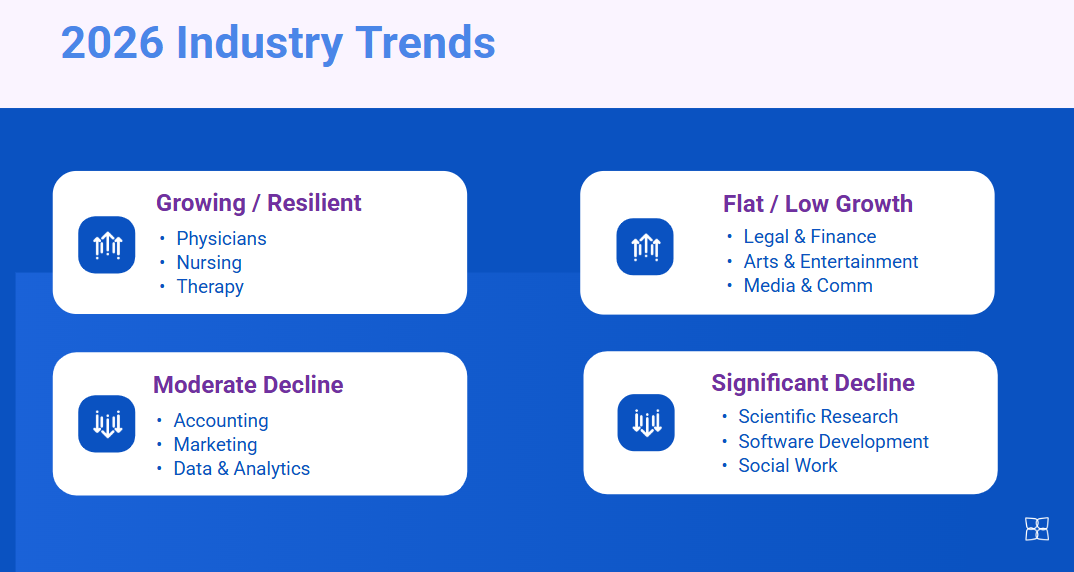
2) Sector reality: growth pockets, flat zones, and a few tougher declines
One of the most important planning moves you can make in 2026 is segment your strategy by profession. “The job market” is not one thing.
Hiring slowed across most industries in late 2025, but specialized talent shortages remain.
What this means in practice for associations
If your sector is resilient, lean into employer relationships and premium positioning. Your value is access to specialized, credentialed professionals.
If your sector is flat, focus on repeatability: renewals, reactivations, and packaging that protects value without racing to the bottom.
If your sector is declining, your career center still matters, but you must elevate it beyond listings. Your retention lever becomes career support, guidance, and connection.
Hypothetical example A marketing association sees fewer entry-level postings and more competition among job seekers. Instead of pushing “more jobs,” the association pivots to “more readiness” by pairing job listings with mentoring, skill-focused resources, and employer messaging that highlights specialization.
3) AI is changing two things at once: hiring noise and member expectations
AI is now influencing both ends of the marketplace.
On the employer side, recruiters are dealing with more noise. When candidates can auto-apply at scale, broad job boards can quickly become an inbox-management problem. Employers still want applicants, but they increasingly want fewer and better.
On the member side, AI is raising expectations, especially for early-career professionals. Entry-level work is changing, and the “baseline” skills employers assume are different than they were even three years ago. That makes the first job search tougher, but it also creates an opportunity for associations to help members build confidence and communicate value.
“Generic job boards are delivering more noise, less value.”
What to do now
Support early-career members with practical guidance: how to demonstrate skills, how to show proof of work, how to network inside the profession.
Treat credentials and specialization as first-class signals. Highlight them clearly in the career center experience.
Build programming that helps members use AI responsibly and effectively, not just “know what it is.”
4) What the job market means for associations: Web Scribble career centers become mission-critical
In tight markets, career centers matter more than in boom cycles. Here’s why.
When hiring is easy, employers can spread spend around and still get candidates. When hiring is selective, they want channels that reduce risk, improve fit, and shorten time-to-hire. Associations can do that by positioning the career center as workforce infrastructure, not a listings page.
“Career centers matter more in tight markets than in boom cycles. Associations that stay passive risk becoming replaceable.”
How associations should respond
Reposition the career center as a workforce solution. Make it clear you provide access to a professional community, not just active job seekers.
Lead with data, not reaction. Track employer behavior and member engagement, then adjust programming and outreach based on what’s actually happening.
Protect value and revenue with repeat employer relationships. One-off postings are fragile. Renewals and repeat hiring partners are durable.
Hiring has normalized after the post-pandemic surge, but employer expectations are sharper. Specialized talent shortages persist in healthcare, technology, and skilled trades, while AI is reshaping both how companies hire and what skills they prioritize. Associations with strong career centers are uniquely positioned to help members adapt.
How is AI affecting the 2026 job market?
AI is changing hiring in two ways: employers increasingly use AI for screening and matching candidates, and job seekers need AI literacy as a baseline skill. Association career centers that offer AI-powered tools—like Web Scribble’s job matching, resume optimization, and Interview Coach—help members stay competitive.
Why are career centers important for associations in 2026?
With hiring normalized and budgets tighter, members look to their associations for career clarity and support. A strategic career center provides job matching, career guidance, and professional development resources that members cannot easily find elsewhere—driving engagement, retention, and non-dues revenue.
What should association career centers do differently in 2026?
Focus on intent-led engagement: use career signals to trigger timely, personalized outreach through automation. Build employer partnerships around outcomes, not just job postings. And invest in AI-powered career tools that help members compete in an increasingly automated hiring landscape.
Closing: a realistic and optimistic 2026 plan
The 2026 market calls for focus, not panic.
If you want your career center to deliver impact with talent and purpose this year, pick one pilot and run it well:
one employer workflow to strengthen (renewals or reactivations are usually the fastest wins),
one member outcome to improve (early-career confidence, credential visibility, mentoring participation),
one reporting view you can share with leadership that ties activity to outcomes.
The associations that win in 2026 will not be the ones with the most postings. They’ll be the ones that prove relevance, reduce noise, and make it easier for employers and members to succeed.
Share this post
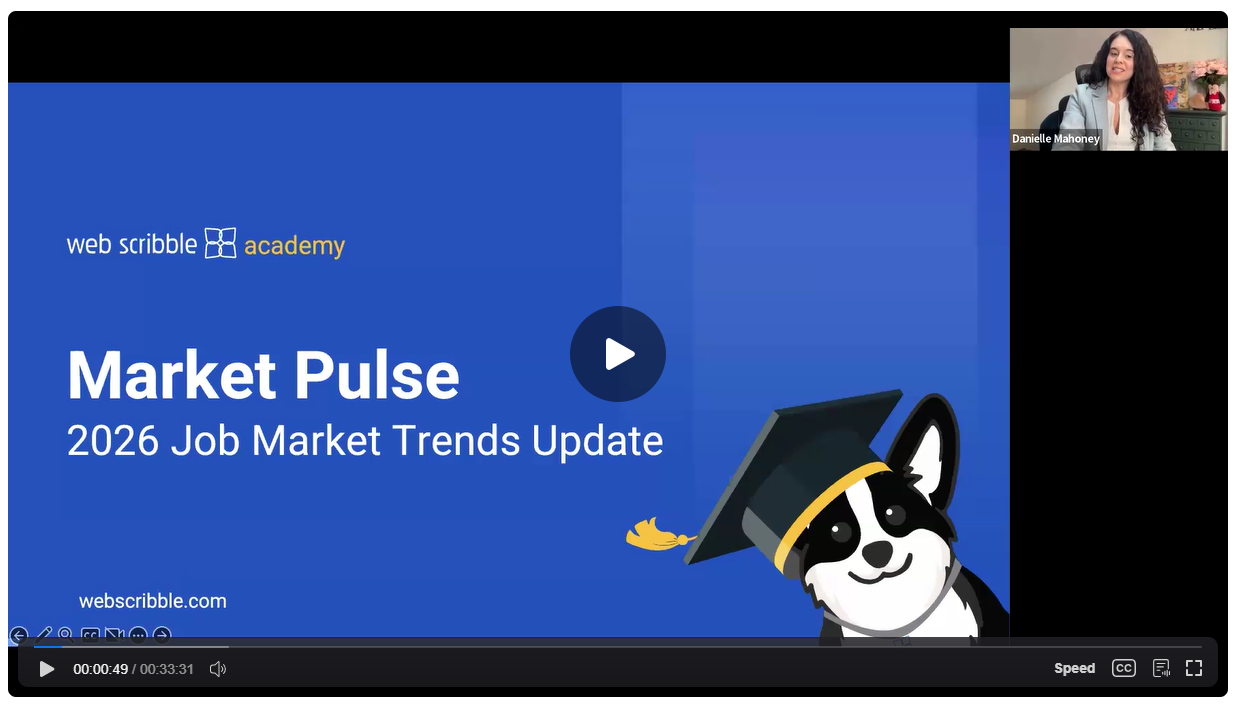
Watch the Market Pulse Job Trends Webinar
Over the last few years, we’ve all watched the hiring market swing from whiplash growth to something calmer and more selective. In our January 2026 Market Pulse, I focused on what that shift means specifically for associations with career centers and job boards.
Reposition the career center as a workforce solution.
See how Web Scribble helps institutions drive better career outcomes for students and alumni.
Thank you! Your submission has been received!
Oops! Something went wrong while submitting the form.
Grow your Community | Deepen Engagement | Drive New Revenue
Position Your Organization as a Leader in Career Outcomes
Join 400+ organizations using Web Scribble to connect member programs with career success. See measurable results in member outcomes, engagement, and non-dues revenue.
%201.avif)