Last updated: July 2026
Most career center RFPs look the same: job posting limits, resume database size, mobile responsiveness, price per posting. These are table-stakes features, not differentiators. When associations treat a career center evaluation like a commodity comparison, they often end up with a platform that posts jobs adequately but leaves meaningful career moments unserved, generates modest non-dues revenue, and requires more staff time than anyone budgeted.
Understanding how career centers fuel association success and strategic growth reframes the evaluation entirely: this is not a software purchase. It is a decision about what kind of career partner your association becomes for members at every stage of their professional lives.
This guide is for the team doing the real work: the executive director who owns member value, the technology leader evaluating integration depth, the finance leader weighing revenue potential against total cost, and the membership director who will live with the data. Use it to move beyond the checklist and evaluate career center software the way it deserves.
Career-Stage Coverage: Who Does the Platform Actually Serve?
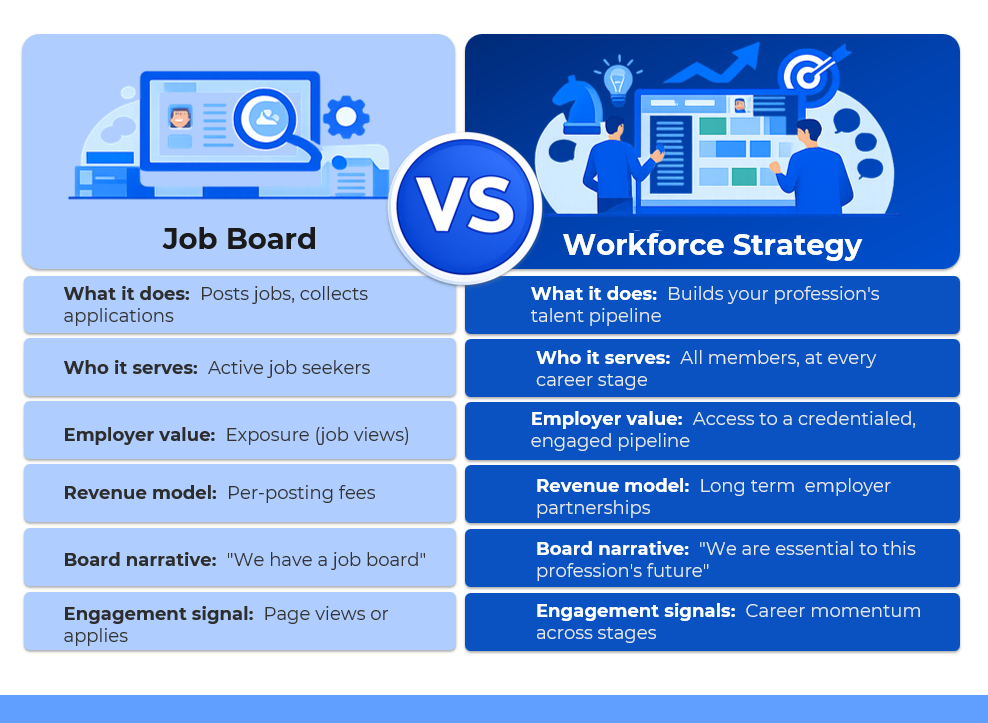
A career center that only serves active job seekers is a job board. An association Career Center serves members at every professional stage: students entering the field, mid-career professionals seeking advancement, senior practitioners looking for board or consulting roles, and employers building pipelines years in advance of a hire.
The best platforms go well beyond job postings — offering tools like salary benchmarking, skills assessments, career coaching access, and content pathways for members who are not actively searching. Career centers built beyond job postings create ongoing reasons for members to engage with the platform, which directly affects your ability to demonstrate Career Center impact to boards and sponsors.
Ask any vendor to walk you through the experience of a member who is not actively searching. If the answer is thin, the platform will have limited reach, and engagement metrics will reflect that.
AMS/CRM Integration: Data Flowing Both Ways
The iMIS 2026 Membership Performance Benchmark Report highlights technology adoption and integrated member data as growing priorities for associations. A career center that lives as a separate island, disconnected from your AMS or CRM, creates real operational friction: manual data syncs, duplicate member records, and an inability to connect career engagement to membership renewal or certification pathways.
The integration questions worth asking are specific: Does the platform support bidirectional data sync or only one-way exports? Can member data update in real time, or does it batch overnight? How does it handle member segments, chapter affiliations, or credential status?
Connecting a career center to iMIS creates measurable engagement outcomes — job board activity feeds into engagement scoring, SSO removes friction for members, and career data becomes part of the member record rather than a siloed dataset. Web Scribble is an authorized iMIS product partner, which means deep, tested integration with one of the most widely used association management systems. That kind of native partnership is worth distinguishing from general API availability.
Behavioral Data and Reporting: From Activity to Insight
Traffic numbers tell you what happened. Behavioral data tells you why, and what to do next. A mature career center platform surfaces data like: which job categories drive the most member sessions, how long employers engage with resume search, where job seekers drop off in the application flow, and which content assets correlate with return visits.
This matters for two reasons. First, it helps your team optimize the experience without guessing. Second, it gives you something concrete to show boards and sponsors when demonstrating Career Center impact. Evaluate not just the reports that exist, but whether the platform gives you the underlying data to answer questions you have not thought to ask yet.
Employer Services and Sales Support: Revenue Beyond the Per-Posting Fee
Career centers with the highest non-dues revenue potential treat employers as a market segment, not just a payment source. That means tiered packages, featured placement options, branding opportunities, talent pipeline programs, and in some cases, virtual or in-person recruiting events tied to the career center infrastructure.
The career center is one of the most direct non-dues revenue sources available to associations — but only when employer services are treated as a product to be sold, not a byproduct of job posting volume. When evaluating platforms, ask specifically: What employer-facing features can you package and sell? Does the vendor provide sales enablement materials, rate card templates, or employer outreach support? What have comparable associations achieved in employer revenue on this platform? The answers reveal whether you are buying a posting tool or a revenue channel.
Implementation and Onboarding: The 90 Days That Determine Year One
Many associations underestimate how much implementation quality affects long-term outcomes. A platform with strong features but a weak launch produces low adoption, frustrated staff, and an uphill battle to demonstrate ROI.
A strategic pre-launch and launch process is what separates career centers that gain traction from those that stall. Ask for a specific implementation timeline, a named project manager, and a clear definition of what "go-live ready" means. Also ask what happens after launch: Is there structured onboarding for your team? Training for staff who were not in the room during implementation? Content templates or employer outreach guides to accelerate your first 90 days? The quality and specificity of the answers often predict the quality of the ongoing relationship.
Ongoing Support Model: What Happens When Something Goes Wrong
Evaluate support the way you would evaluate any operational dependency. What are the response SLAs? Is support handled by a dedicated team or a general help desk? Is there a customer success function, and if so, how is it structured? Do you have a named point of contact who knows your configuration and history?
For associations with small staff teams, responsive and knowledgeable support is not a nice-to-have. It is a direct operational risk if it is absent. Get specifics, not brochure language.
Revenue Structure and Fee Transparency: Total Cost of Ownership
Career center pricing has become more varied and in some cases more opaque. Flat licensing fees, per-posting models, revenue share arrangements, and hybrid structures each carry different risk profiles depending on your volume and growth goals.
Before signing, build a full three-year total cost model that includes: platform licensing, AMS integration fees (one-time and ongoing), implementation costs, training, content migration, and any per-transaction or volume-based charges. Ask what happens to your costs as employer revenue grows. Ask what fees exist that are not in the base contract. Clarity here protects your budget and your board relationship.
Product Roadmap and Long-Term Ownership
Software you license today will look different in three years. The question is whether it will look better or just older. Ask vendors to walk you through what has shipped in the last 12 months and what is planned for the next 12. How are customer requests incorporated into roadmap decisions? What is the ownership and investment model behind the product?
A career center platform operated by a team with long-term investment in the association market behaves differently, in product decisions, support culture, and partnership quality, than one managed as a legacy product within a larger portfolio.
Weighted Evaluation Matrix
| Criteria | Weight | What to Look For | Key Questions to Ask |
|---|
| Career-stage coverage | 20% | Tools and pathways for active seekers, passive members, and employers | What does the experience look like for a member who is not searching? |
| AMS/CRM integration | 20% | Bidirectional sync, real-time updates, SSO, engagement scoring | Is data sync real-time or batched? How are member segments handled? |
| Behavioral data & reporting | 15% | Job category performance, employer engagement, drop-off analysis | Can we access the underlying data, not just preset reports? |
| Employer services | 15% | Tiered packages, featured placement, branding, pipeline programs | What employer features can we package and sell? |
| Implementation quality | 10% | Named PM, defined milestones, post-launch onboarding | What is included in the first 90 days after go-live? |
| Ongoing support | 10% | Dedicated CSM, named contact, defined SLAs | Who is our point of contact after implementation? |
| Revenue structure | 5% | Transparent fee model, three-year cost clarity | What fees exist outside the base contract? |
| Product roadmap | 5% | Active release history, customer input process, long-term ownership | What shipped in the last 12 months? |
Moving Forward
The associations getting the most from their career centers are not necessarily running the most feature-rich platforms. They are running platforms that integrate cleanly with their member data, serve members across career stages, and generate employer revenue that compounds year over year. They also have partners who show up when something needs to change.
Evaluation done well takes time. But it is far less expensive than a re-platform 18 months after a decision made too quickly.
Ready to see what a Career Center built for associations looks like in practice? Schedule a demo with Web Scribble to explore how the Career Center connects with your AMS, serves your members, and grows non-dues revenue for your association.
Related Resources and Next Steps
Sources
%201.avif)