6
min read
Measuring Early-Career Member Momentum Before Renewal
Track five meaningful signals of early-career member progress and apply a simple 30/60/90-day review before renewal.

%201.avif)
Track five meaningful signals of early-career member progress and apply a simple 30/60/90-day review before renewal.



Renewal is one of the clearest measures of member value, but it is also one of the latest. By the time an early-career member reaches a renewal decision, the association has already had months of opportunity to help that member find direction, build confidence, make connections, and move forward professionally.
That makes a more useful question: What signs tell us a member is building momentum before renewal?
For early-career members, those signs are often visible in what they discover, use, complete, and return to.
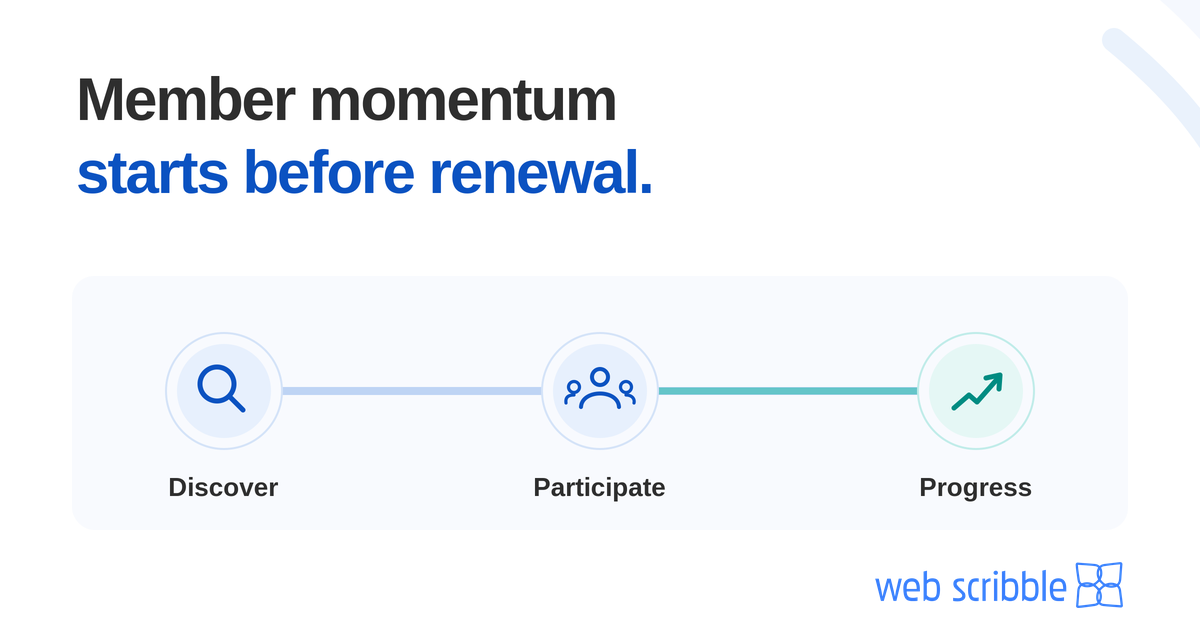
A renewal report tells you who stayed. It does not tell you whether a member found useful career value in month two, connected with someone in month four, or reached an important professional milestone in month six.
Early-career engagement also does not always look like traditional participation. A newer member may not immediately join a committee or volunteer. They may instead:
Those actions can help an association understand whether the member is finding practical value. For a broader view of the relevance members now expect, see What Members Expect From Career Support in 2026.
The goal is not to score every click. It is to identify a small set of meaningful signals that show professional movement.
The first question is simple: did the member find something relevant to where they are now? For an early-career member, that might include:
Useful measures include first visits, repeat visits, registrations, saved resources, and movement from a general member experience into a career or learning experience.
The better question is not "Did they visit the website?" It is: Did they discover something that can help them move forward?
Career activity can reveal current professional needs. A job application, job alert, resume update, salary lookup, interview-preparation activity, or career-path exploration may indicate that a member is actively navigating a transition.
Those signals give the association context. A member applying for jobs may need something different from a member who just completed a credential or accepted a new role. That context can help the association make the next interaction more relevant.
Early-career members often need access to people as much as they need information. Mentoring, peer discussion, community participation, office hours, networking, and introductions to experienced professionals can create a stronger sense of belonging and practical support. A mentoring application, discussion reply, community introduction, or first networking event can all indicate movement from passive membership toward participation.
Strong engagement is not only about activity. It is about progression. If a member completes a credential, what happens next? If they attend a career webinar, are they guided to a practical resource? If they update a resume, are they exposed to relevant jobs, interview support, or a career guide? The strongest engagement model asks whether the association is helping a member move from one useful step to another.
This is where connected systems and intentional follow-up matter. A credential, job application, resume update, or role change can become a signal for the next relevant action. The Success Layer: Six Steps to Turn Career Signals Into Member Momentum offers a practical framework for connecting those signals to coordinated next steps.
The presence of a second step is often one of the clearest signals of momentum. Examples include:
The association does not need every member to follow the same path. It needs enough visibility to understand whether an initial interaction is becoming ongoing value.
A useful early-career dashboard should not reward activity for activity's sake. Ten email opens are not necessarily more valuable than one completed mentoring match. Five website sessions are not automatically more meaningful than one resume update followed by a job application. The strongest measures are tied to member progress.
A simple way to evaluate a signal is to ask:
If the answer is yes, the signal is probably worth tracking.
Associations do not need a complex analytics program to begin. A lightweight model can help teams understand whether early-career members are discovering and using value during their first months. The Explore to Mentor framework provides a broader six-stage view for connecting those early actions to the full member career journey.
Look for whether the member has found at least one high-value resource or experience relevant to their stage. Examples:
Look for a deeper action. Examples:
Look for movement from one useful action to the next. Examples:
The purpose is not to force a standardized journey. It is to see whether members are finding momentum.
Measurement becomes valuable when it changes what the association does next. A member who applies for a job may benefit from interview coaching or salary information. A member who completes a credential may be ready for role exploration, a new opportunity, or a conversation with an experienced professional. A member who updates their role may be ready for a different community, learning path, or leadership opportunity.
The association does not need to automate every response immediately. Start with a few meaningful signals. Decide what the most relevant next action should be. Then connect those signals to the systems, teams, and communications you already have.
That is how early-career engagement becomes more than a renewal metric. It becomes a way to understand whether members are moving forward, while helping the association close the member value perception gap with evidence members can feel.
We are exploring this topic in our October 21 Web Scribble Academy session, Why Early-Career Members Leave: And How to Make Them Stay.