The Success Layer: Six Steps to Turn Career Signals Into Member Momentum
Associations have a unique advantage in the workforce marketplace: trust, standards, and proximity to professional growth. The Success Layer framework builds on that strength by helping you connect what you already do
Associations are uniquely positioned to deliver career growth with credibility because you sit at the intersection of standards, learning, community, and employer demand. The question many teams are tackling now isn’t whether you have valuable resources. It’s how to make those resources feel guided, connected, and measurable across the member experience.
That’s exactly what Web Scribble’s recent webinar on the Success Layer delivers: a practical, platform-agnostic framework for turning career behavior (signals) into coordinated next steps across your AMS, LMS, community, website, and career center, using the tools you already have.
If you haven’t watched the session yet, start with the recording (and share it with your membership, education, marketing, and revenue teammates). It’s designed to spark a simple 90-day pilot you can run within your current engagement tech stack.
The big idea: Connect the ecosystem you already run
Most associations deliver benefits through a multi-platform ecosystem: AMS/CRM, website and portal, learning systems, community, events, and a career center. Each tool may be doing its job—but members experience them as separate destinations unless you intentionally connect the steps.
The Success Layer approach is a lightweight way to make your ecosystem behave like a coordinated journey:
Members understand where they are and what to do next
Staff teams share the same map and language
Employers experience clearer outcomes and more targeted value
This aligns with what member experience research continues to emphasize: members respond to value that’s easy to find, relevant to their goals, and supported across touchpoints—not scattered across platforms.
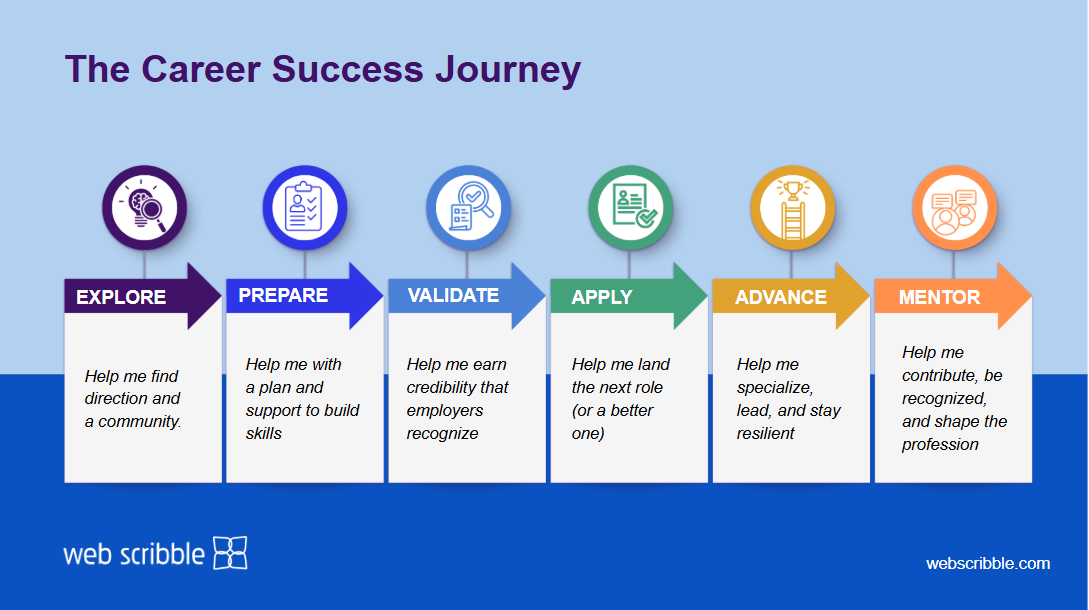
Step 1: Map your member career journey in six stages
This is not a request to create six new programs—or six new departments. It’s a labeling exercise: define the stages and assign the resources you already offer to each one. That alone gives your team a shared blueprint for guiding members forward.
Action you can take this week
List your top 25 member-facing assets (courses, credentials, toolkits, communities, events, mentoring, volunteer roles, career services).
Assign each to one primary stage.
Identify the two stages where you’re strongest - and the two where members might need clearer “what’s next” guidance.
Hypothetical example: A technical association finds it’s strong in Prepare (robust CE) and Validate (credentialing support), but weaker in Apply and Advance. Their pilot focuses on connecting credential milestones to targeted job alerts and a simple leadership pathway, so members can move from achievement to opportunity without friction.
Step 2: Define the “Success Layer” in plain language
The Success Layer is the connective tissue that turns career behavior into coordinated action:
Interpret career behavior as a signal
Update a member’s stage and preferences
Trigger the right next step in the right channel (portal, email, community, LMS, career center)
What makes this framework usable is its practicality: you can start with integrations where they exist, and use simple operational approaches where they don’t - tags, segmented lists, scheduled exports, and basic automations. The point is not technical perfection. It’s repeatable momentum.
Step 3: Strengthen your member profile with two fields
One of the most actionable recommendations from the webinar is also one of the simplest: add two fields to your AMS (or system of record):
Career stage
Pathway / specialty interest
Those two fields unlock segmentation and personalization without requiring a mountain of data. When members tell you what they’re working toward, you can tailor what they see, what they’re invited to, and what you recommend—across platforms.
How to implement without friction
Add pathway selection to onboarding, renewal, or a “Update your profile” nudge.
Offer 6–10 pathway options (enough to be useful, not overwhelming).
Let members change it anytime (career goals shift).
Hypothetical example: An HR-focused association adds “Career Pathway” to the member profile. The member portal now displays a “Start Here” panel based on that choice: one recommended learning plan, one community space, and one career action. Same resources, clearer direction.
Step 4: Track fewer signals—make them more actionable (10–15 max)
A hallmark of the Success Layer framework is restraint. Instead of tracking everything, track the signals you can act on. The webinar suggests keeping your success signals to 10–15 total, anchored to three questions:
Did they start?
Are they moving?
Did they stall?
Here are examples of stage-aligned signals you can operationalize quickly:
Explore: pathway selected, role browsing, first community join, orientation completion
Prepare: learning plan started, milestone completed, cohort participation
A simple test: If you can’t explain the signal and the next action in one sentence, it’s not a Version 1 signal.
Step 5: Build a Career Hub page (one link that reduces friction)
If you do one structural change that improves adoption across platforms, make it this: create a Career Hub landing page in your member portal (or behind login on your website). The hub becomes the navigational anchor members can remember, bookmark, and return to.
A Career Hub works because it turns scattered tools into a guided experience. It also gives staff one consistent place to drive traffic from emails, community posts, onboarding sequences, and event follow-ups.
What to include (start small)
“Where you are now” (stage + pathway)
The next 1–2 best actions (not five)
One recommended learning plan or milestone
Credential progress links (if applicable)
Job alerts / saved searches (Apply)
A small “Contribute” on-ramp (Mentor/Lead)
This same concept shows up in Web Scribble’s broader guidance about moving from “job board” to “strategic career center”- with career signals powering engagement and retention across your ecosystem.
Step 6: Turn employer relationships into outcome-based partnerships
A standout strength of the Success Layer approach is that it supports non-dues revenue growth without compromising member trust - because the value is tied to outcomes members want: readiness, credibility, and opportunity.
Instead of treating employer value as a transaction (post a job, get clicks), the framework encourages you to package employer participation around career outcomes:
Sponsoring a pathway plan or milestone series
Supporting credential prep resources that reduce screening friction
Funding leadership development, mentoring, or a community of practice
Participating in structured career events (role-based AMAs, resume reviews, hiring manager Q&As)
This aligns with partnership guidance from ASAE that emphasizes aligning around shared goals and ongoing value, not one-off logo placements.
A 90-day pilot your team can run
The fastest way to move from strategy to action is a short cross-functional working session (60–90 minutes) with membership, education, career center, marketing, and revenue stakeholders. Use these four questions from the webinar to guide the conversation:
Which 2–3 actions would create the most momentum in 90 days?
Where can employers sponsor outcomes without compromising member trust?
Then end with one clear decision:
First play: What you will focus on (one stage)
Success signal: What “movement” looks like
Channels: Where the next step will show up (at least two)
If you’re building automation into the process, Web Scribble’s posts on Playbooks are helpful for thinking about “if-then” triggers tied to real career center behavior: Turn Your Career Center Into an Always-On Engagement Engine with Playbooks.
The Success Layer framework is optimistic by design: it assumes you already have meaningful assets and that small, well-chosen signals can help members experience those assets as a coherent journey. When members know what to do next (and why), engagement becomes easier to sustain, impact becomes easier to report, and employer value becomes easier to package around real outcomes.
Next step: Watch the webinar recording, pick one stage to strengthen, define 2–3 signals, and run a 90-day pilot that connects the next step across your portal, email, and community.
%201.avif)