Last updated: July 2026
Most career center RFPs produce responses that are carefully worded to sound compliant without committing to anything specific. That is not a vendor problem. It is an RFP problem.
Vague requirements invite vague answers. These 12 requirements are written to go directly into an RFP document. Each one is specific enough to require a concrete response — not a marketing paragraph. Before you draft, read through how to evaluate association career center software holistically so your scoring framework is ready when responses come in.
Requirement 1: Member Career-Stage Coverage
The platform must support members at all professional stages, including students, mid-career professionals, senior practitioners, and those pursuing board or leadership roles. Describe the specific tools, content pathways, and engagement features available to members who are not actively searching for a job.
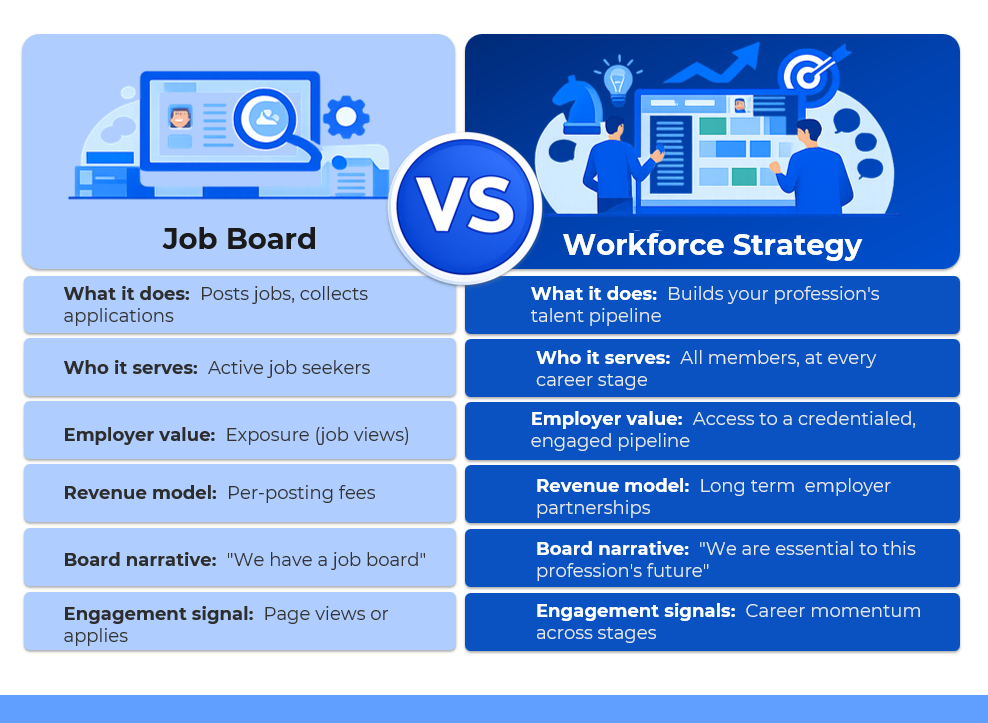
Why it matters: A career center that only serves active job seekers is a job board. Career centers built beyond job postings generate ongoing member engagement — which affects renewal rates, not just traffic.
Requirement 2: AMS Integration Specification
The platform must support bidirectional data synchronization with [your AMS]. Describe: (a) whether sync is real-time or batched, (b) which member fields are synced, (c) how membership status, credential status, and chapter affiliation are handled, and (d) whether SSO is included in the standard integration or is an additional fee.
Why it matters: A career center disconnected from your AMS creates manual overhead and prevents career engagement data from informing membership renewal and certification decisions. Web Scribble is an authorized iMIS product partner, which means native, tested integration rather than general API access.
Requirement 3: Employer Account Management
The platform must include employer-facing tools that allow employers to manage job postings, access a searchable member resume database, and purchase tiered advertising packages. Describe the employer dashboard and the reporting available to employer accounts.
Requirement 4: Non-Dues Revenue Package Configuration
Describe the employer packages the platform supports, including featured job placement, banner advertising, sponsored content, and talent pipeline programs. Provide pricing structures comparable associations have used and typical employer revenue ranges for associations of similar size.
Why it matters: The career center is one of the most direct non-dues revenue sources available to associations — but only when employer services are treated as a product to be sold rather than a byproduct of job posting volume.
Requirement 5: Behavioral Data and Reporting Access
The platform must provide reporting that includes: (a) member session activity by job category, (b) employer resume search engagement, (c) job seeker application funnel data, and (d) export capabilities to your team's preferred BI or analytics tools. Specify whether this data is available in raw export format or only through preset reports.
Requirement 6: Career Content and Resource Capabilities
Describe the career content tools included in the platform: salary benchmarking data, skills assessment tools, career coaching integrations, webinar or event hosting, and resource libraries. Specify which are included in the base license and which are add-ons.
Requirement 7: Mobile and Accessibility Standards
The platform must be fully responsive on mobile devices and meet WCAG 2.1 AA accessibility standards. Provide documentation of your most recent accessibility audit and describe your process for addressing reported issues.
Requirement 8: Implementation Timeline and Milestones
Provide a detailed implementation timeline from contract execution to go-live, including named project milestones, team composition with a dedicated project manager, and what is required from the association at each stage. Define your criteria for "go-live ready."
Why it matters: A strategic launch process is what separates career centers that gain traction immediately from those that stall in the first 90 days.
Requirement 9: Post-Launch Support Structure
Describe the support model available after go-live, including: (a) response SLAs by issue severity, (b) whether support is handled by a dedicated team or general help desk, (c) whether a named customer success manager is assigned, and (d) availability of ongoing training for new staff.
Requirement 10: Pricing and Fee Transparency
Provide a complete fee schedule that includes: base platform license, AMS integration (one-time and recurring), implementation, training, content migration, and any per-transaction, volume-based, or tier-upgrade fees. Describe what happens to platform costs as employer revenue and job posting volume grow.
Requirement 11: Data Ownership and Portability
Confirm that [Association Name] retains full ownership of all member and employer data on the platform. Describe the data export process, formats available, and timeline for data delivery in the event of contract termination.
Requirement 12: Product Roadmap and Development Process
Summarize the product features released in the past 12 months. Describe your roadmap process, including how customer requests are surfaced and incorporated. Provide information on the ownership structure and investment model behind the platform's continued development.
Scoring Responses
When vendor responses arrive, use a consistent weighted framework. Requirements 1–5 carry the most weight for associations where the career center is a core member benefit and a revenue channel. Requirements 8–10 carry more weight for teams with limited IT capacity or small staff. Scoring guidance is covered in full in the evaluation framework — use it alongside this scorecard.
Moving Forward
A well-constructed RFP shortens the evaluation cycle, surfaces gaps that vendors would otherwise obscure, and gives your board documentation of a credible process. It also sets the tone for the vendor relationship before the contract is signed.
Ready to see how Web Scribble responds to requirements like these? Schedule a demo to walk through the platform against your specific AMS, member profile, and revenue goals.
Related Resources and Next Steps
Sources
%201.avif)