Why Career Support Is Becoming a Workforce Strategy for Associations
A recap of Web Scribble’s April 29 webinar on why associations should move beyond job boards and connect career support, employer relationships, credentials, and member engagement into a workforce strategy.
Share this post
Last updated: May 2026
During our April 29 webinar, Stop Running a Job Board. Start Running a Workforce Strategy, the central message was simple: career support has become too important to treat as a standalone member benefit.
Hiring conditions are tighter. Employers are more selective. Members are making career decisions in a market that often feels harder to navigate than the headline numbers suggest. For associations, that creates an opening to connect career resources, learning, credentials, employer relationships, and workforce insight into something more strategic.
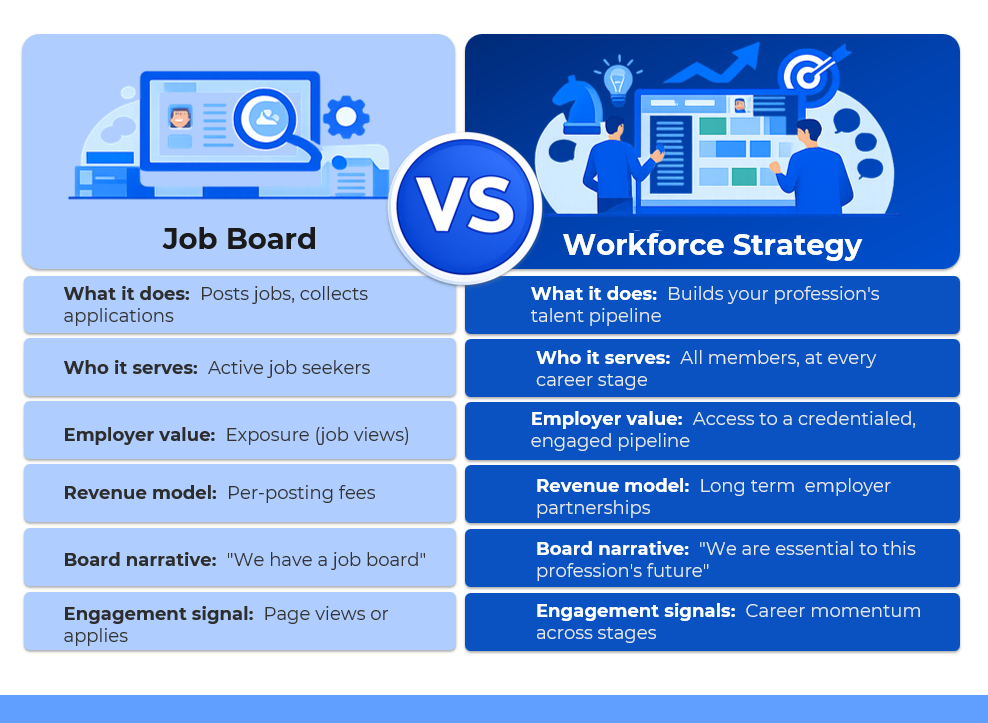
A job board can help members find open roles. A workforce strategy helps members understand where opportunity is moving, what skills are gaining value, how credentials connect to advancement, and which employers are actively investing in the profession.
That is a bigger role, and it is one associations are uniquely positioned to play.
The labor market is changing the career support conversation
The labor market is not frozen, but it is more cautious than it was a few years ago. The Bureau of Labor Statistics reported that February 2026 hires fell to 4.8 million, with the hires rate at 3.1%, the lowest since April 2020. LinkedIn’s March 2026 Workforce Report also showed national hiring down 6.8% year over year and 23% below its pre-pandemic pace.
For members, that shows up as a more selective job search, longer timelines, and more uncertainty about which skills, credentials, and roles are worth pursuing next. TopResume’s 2025 Jobseeker Trends Report found that 64.8% of job seekers believe getting hired is tougher now than before, and the report also highlights how emotionally draining the modern job search has become.
Those realities matter for associations because career confidence is part of member confidence. When members are trying to interpret a changing market, they look for trusted sources that understand their profession. Associations already have the ingredients: subject matter expertise, employer relationships, learning pathways, credentialing programs, peer networks, and a mission tied to advancing the field.
Moving from a job board to a workforce strategy expands career support from active job seekers to members at every career stage.
This is especially important because members do not experience their careers in isolated categories. A member may start by browsing roles, then realize they need a credential, attend a webinar, connect with a mentor, and later return as an employer or volunteer leader. If those experiences are disconnected, the association delivers value in fragments. If they are connected, the member sees a pathway.
The six pillars of an association workforce strategy
The webinar introduced a six-pillar framework for building that pathway:
Know your industry’s workforce gaps. Use labor market data, employer conversations, and member behavior to identify the roles, skills, and talent needs shaping your field.
Build career pathways, not just job listings. Help members understand the roles available to them, the skills required, and the learning or credentials that support each next step through tools like career path software and career guides.
Make credentials count in hiring. Communicate credential value clearly to both members and employers, so education and certification connect directly to workforce outcomes.
Turn employer relationships into workforce partnerships. Move beyond transactional posting packages and build relationships around talent access, pipeline development, upskilling, and visibility in the profession.
Use career signals to drive smarter engagement. Treat job alerts, resume activity, content clicks, credential interest, and employer engagement as signals that can help the association understand what members need next. This is where career signals become member momentum.
Prove workforce impact to your board. Report outcomes, not just activity. Show how career engagement connects to member value, non-dues revenue, employer relevance, and mission impact.
None of these require an association to start from scratch. Many associations already have the pieces. The strategic work is making the connections visible, measurable, and useful across the organization.
What this looks like in practice
A workforce strategy does not have to begin with a major technology project. It can start with a sharper operating rhythm.
For example, an association might identify three high-demand roles in its field using BLS data, employer feedback, and career center activity. Then it can map those roles to existing learning resources, credentials, webinars, mentoring opportunities, and member stories. The next member email does not simply say, “visit the career center.” It says, “if you are exploring this role, here are the skills, credentials, and opportunities that can help you take the next step.”
That is a different member experience. It is more specific. It is more useful. And it gives staff a clearer story to tell across membership, education, marketing, employer sales, and leadership reporting.
The same idea applies to employer engagement. Instead of selling job postings alone, the association can talk with employers about the roles they need to fill, the skills they value, and the member audiences they want to reach. That opens the door to richer partnerships: sponsored career content, credential visibility, talent pipeline campaigns, virtual career fairs, and workforce insight reports.
A practical 90-day starting point
For associations that want to move from concept to action, the webinar outlined a realistic 90-day path.
Days 1 to 30: Identify the workforce story. Choose three to five roles, skills, or workforce gaps that matter in your field. Use public labor market data, recent employer conversations, and career center activity to build a simple picture of demand.
Days 31 to 60: Connect existing resources. Map those workforce needs to your current assets: learning programs, credentials, articles, webinars, mentoring, employer relationships, and career center content.
Days 61 to 90: Share the story. Create a one-page workforce brief for leadership, members, or employers. Include what you are seeing in the market, what resources the association offers, and what members or employers can do next.
Members renew when the association remains relevant to what they are trying to accomplish. Career support is one of the clearest ways to create that relevance because it ties directly to progress: finding direction, gaining skills, earning credentials, connecting with employers, and advancing over time.
When career resources are connected into a larger workforce strategy, the association can serve members at more moments across their professional journey. Early-career members see pathways into the field. Mid-career members see advancement options. Senior members see ways to lead, mentor, and strengthen the profession.
That is the larger opportunity: not simply more job postings, but more visible progress. It is why the strongest association career centers are becoming strategic platforms for member engagement, employer value, and long-term workforce impact.
For the full Member Success Journey framework, including how career support connects to member outcomes, employer access, and mission impact, the white paper is the right next step: download the Member Success Journey white paper.
The next webinar in the series is May 27: From Student to Mentor: Designing Career Experiences That Keep Members for Life. Registration is open at webscribble.com.
Web Scribble helps associations build career centers that support members at every stage of their professional journey.
Frequently Asked Questions
Q: What is the difference between a job board and a workforce strategy? A: A job board helps members and employers connect around open roles. A workforce strategy connects jobs, skills, credentials, career pathways, employer demand, and member engagement into a clearer long-term value story.
Q: Why should associations lead this conversation? A: Associations understand their profession, maintain trusted member relationships, and already manage many of the resources that shape career progress. That gives them credibility generic career platforms cannot easily match.
Q: How can a workforce strategy support non-dues revenue? A: It gives employers a stronger reason to partner with the association beyond single job postings. Talent pipeline visibility, sponsored resources, career events, and workforce insight can all support a more durable revenue model. For more on that, see the association non-dues revenue playbook.
Q: Where should an association start? A: Start by identifying a small set of high-priority roles or skills in your profession, then map those needs to existing resources members and employers can use now. The first goal is clarity, not complexity.
%201.avif)